


Marketing buckles under its own need to follow trends. A great many things don’t change. Or they change slowly, and we know what they’re changing into.
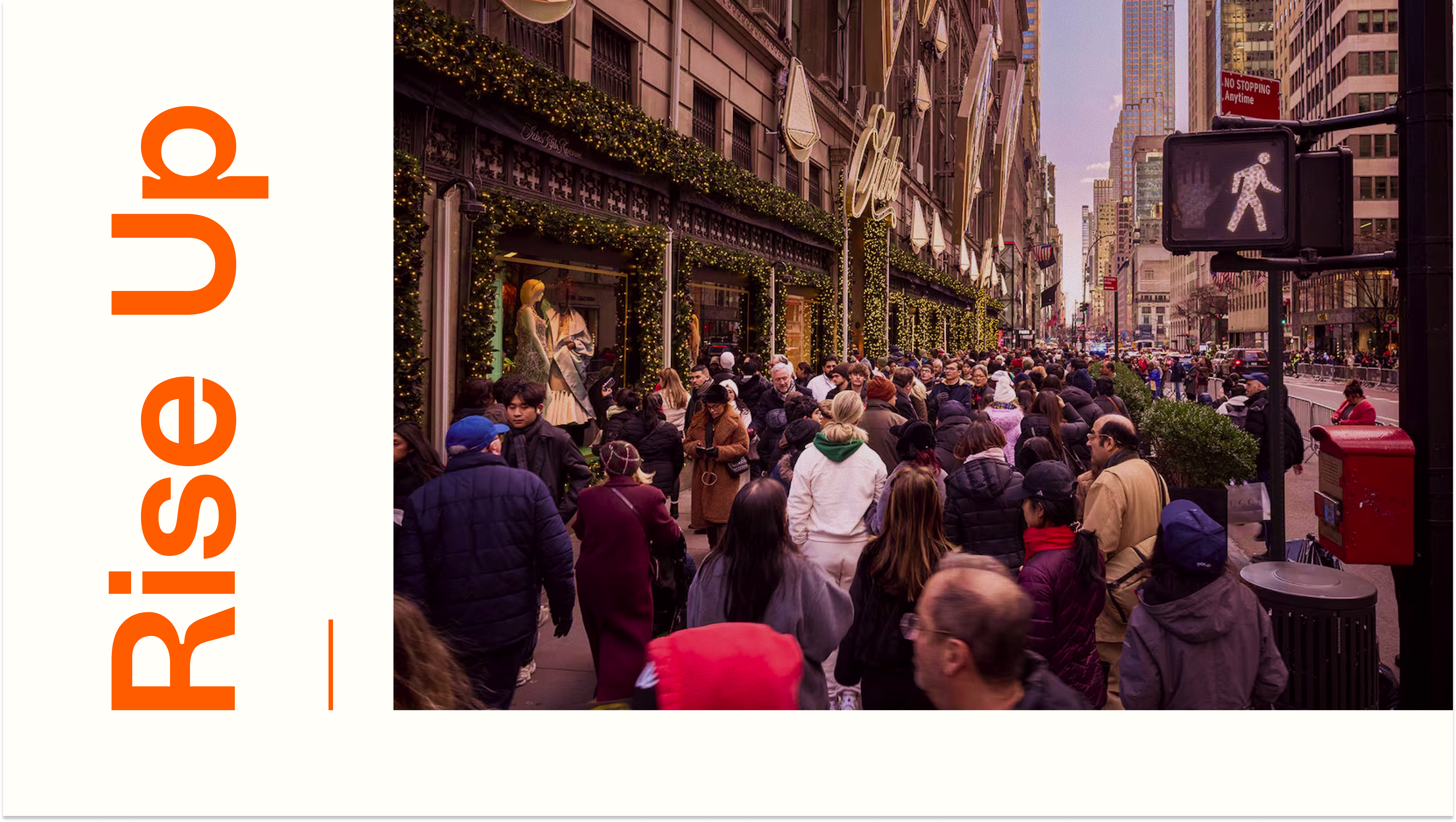
Black Friday is one of those. Not that long ago it was something new. Now it’s just another margin-eroding mess in the promo calendar.
The future? Year-round dynamic pricing, made possible by AI. It takes retail back to the days when the shopkeeper sized up the customer as they walked in, then made up the price.
For that I have a story.
Updated from last year’s Issue 79, mostly unchanged.
❦
Ask around and most people can’t tell you when Black Friday is.
Fact: only 19% of people now think of Black Friday as the starting gun to Christmas shopping. Shoppers are now scattered across weeks, some starting in October, others waiting until December.
Which leaves marketers with a problem: how do you make your brand cut through when it’s all just blurred into one long pre-Christmas promotional haze?
Answer: You don’t.
So, despite being the most important moment of the retail calendar, yada, yada, Black Friday campaigns settle into one of two copy-paste options.
First, the apology ad.
To understand this, you need to know that nothing drives engagement like a good corporate mea culpa. The algorithm loves an apology.
This year’s brand “crises” have trained us well. Coca-Cola, Neutrogena, Starbucks, Callaway, Novig, Hyrox, Target. The “we hear you” reaction statement is now a meme. And because viral outrage is now largely performative, brands can bank the gains.
A scandal can drive more relevance than the last twenty years of a brand’s advertising.
The Black Friday apology ads are like bad comedy sketches on the above. Brands pretending to apologise for having offers. “We just couldn’t help ourselves, sorry for any joy this may cause.”
The irony is supposed to tickle the algorithm. The sorry-not-sorry format lets them seem knowing, detached, above it all, while still desperately slashing prices like everyone else.
Second, the conscientious objection.
This is where brands throw up the peace signs instead of the promo banners. Black Friday is wrong. Think before you buy. The climate crisis won’t wait. We’re all complicit in a system of overconsumption. Stores close for the day. You get told to go outside and hug trees. Some even raise prices and donate the difference to sustainable causes.
It’s basically the Patagonia playbook, except these brands will happily sell you whatever you want, however much you want, on literally any other day of the year. Just not today.
Sort of like a bartender who’ll pour you doubles every night of the week but suddenly grows a conscience when it comes to happy hour.
So how did this stuff actually perform?
Last year, U.S. e-commerce hit $11.8 billion on the day, up 9.1%. The U.K. spent roughly £3.8 billion online over the four days, a 4.6% increase. This year the U.S. forecast is $12.9 billion, up another 9.2%. In the U.K., Omnisend asked shoppers what they plan to spend: £9.9 billion across Black Friday and Cyber Monday, and that’s down a third.
Whichever way you look at it, Black Friday is still huge, from a revenue spike standpoint.
But store footfall? Flat last year, and forecast to fall this one.
It’s the same old story: physical retail keeps losing to the screen. Customers sit there with twelve tabs open, playing one off the other. Last year the traffic AI sent to U.S. retailers on Black Friday rose 805%. This year it’s forecast to nearly double on top of that. And those shoppers now buy at nearly twice the rate of everyone else.
But AI has a much better trick coming: year-round dynamic pricing.
We hate it now — airlines, Uber, the price jumping every time you refresh. But it’s early days. As the technology improves, it’ll know what you’ll pay at any given moment. Better than you know yourself.
Which takes retailers back to the 19th century, before price tags existed. Back when shopkeepers looked at who walked through the door and decided what to charge based on who they were, how they looked, and how desperate they seemed.
For now, seasonal promotions are becoming exactly what they look like: generic, routine, defensive. A margin-eroding scramble where the numbers are big, but the wins are few.
❦
Something lost, something found
It is the day after Black Friday, and the only thing my son wants is a plectrum. I need it just as badly. That tiny sliver of plastic so we can play guitar for half an hour like I’ve promised.
I haven’t been around much lately. Made the promise on Tuesday when the weekend was far away. Now it’s here, there’s everything else. Things I need to catch up on. Things piling up.
“You said Saturday,” he pleads, desperate to believe.
I reach for an excuse. Almost. But the pile of broken promises is already too high. I can’t reach up far enough this time.
I exhale hard.
“Fine,” I say. “Let’s do it.”
He bolts. Guitar. Amp. Jack cable. Power cable. Amp on. Hum. Guitar strap. Over his shoulder. Adjusting. Ready.
Then we both freeze.
No plectrum.
Silence.
The. Smallest. Of. Things.
“It was right here,” he says.
“Well, it’s not now, is it?” I bark.
My tone is cruel. He just looks at me. Shame floods in quicker than I can take it back.
We try the usual spots. Amazon can’t deliver for a week. The big-box stores don’t have that kind of thing.
There is this one place. But I don’t hold hope.
I figure we’d better try.
We tuck ourselves down a side street off Shepherd’s Bush, past the market. I’d walked past this place a lot of times in a past life. Real keys-on-hooks shop. It was always impossible to tell if it was ever open. Dusty window, faded Fender Authorised Dealer sticker, security railings with orange rust.
I push on the front door. Metal handle. Cold. To my mild disbelief, it clanks open. Bell rings.
Inside it smells like solder and ferric oxide. Random tube amps stacked in corners, compressors with peeling labels, a vintage drum machine half-buried under curled-up cables. Equipment everywhere, no logic to it.
And then, there, under the glass counter, a small wooden box full of plectrums.
I can’t believe it.
“Just need a few picks,” I say.
“Take your time,” the man says.
Late sixties maybe. Hoodie over a collared shirt. He looks like the kind of guy who’d loaded out a thousand venues. I notice a near-finished bottle of rum behind the counter. Sailor Jerry. Next to it, a tea mug stained at the rim. Maybe he’s poured a shot in.
My son hovers over the tray, picking carefully. He chooses six: a bright red, a tortoiseshell, one with a skull, two anonymous blacks, and a neon green.
“That’s five pounds,” the man says.
I reach for my wallet. I only have American Express. I’m a fool.
“Ah. No dice. Sorry mate.”
“Of course,” I say, reeling in the awkwardness. I can buy anything except what matters most right now.
The man looks at my son, smiles. “You play?”
My son nods.
“Keep ‘em then,” he says. “Musician to musician.”
I turn to my son. “That’s so kind.”
The relief is... immediate.
“We’ll get some cash,” I say to the man. “Come back properly.”
He nods. “I’ll be here.”
All week, I kept seeing the slight nod he gave my son when he said musician to musician. Hand pressed briefly to his chest. Like he’d done this before. Handed over the right thing to the right player at the right moment.
So, the next Saturday morning, we went back.
We brought a bottle of decent dark rum — not Sailor Jerry. A thank you. And a crisp five-pound note in a simple card, a fresh open envelope, because that felt right. My son walked in holding both.
“Thank you for the plectrums,” he said, placing the bottle on the counter. “And here’s the five pounds.”
The man blinked.
“Well,” he said, trying to hand the money back. “That’s... that’s very... kind.”
“We made a deal,” my son announced. A lump swelled in my throat. A deal we’re keeping.
The man looked at the rum. Nodded once, slow. “Good choice.”
Then he turned to my son.
“You wanna try something loud?”
He fired up a vintage Marshall — the kind you feel in your guts — and handed over an old Epiphone. My son hit a few awful notes that screamed off the walls.
I shook my head, like we were about to get thrown out. But the man was already grinning, leaning back against the counter like he was exactly where he wanted to be.
“Make a lot of noise first,” he said, nodding toward my son, “find the notes after.”
Then, almost to himself:
“That’s what Ronnie used to say. It worked for him.”
He glanced at me. A beat.
I caught it.
That’s when I noticed it. A small frame. Propped against the back of the Marshall, half-hidden by a pack of strings. Easy to miss. I had to look twice. Sun-faded, slightly askew. But it was Ronnie Wood, unmistakable, arm slung around someone who looked suspiciously like the man standing in front of us, just twenty years younger, clearer-eyed.
I didn’t ask.
We all shook hands, the kind that said: We’re good here today.
“Merry Christmas,” the man said.
On the way home, my son didn’t say much. Just looked out the window, one hand in his coat pocket, still curled around those plectrums. They never left him after that. Right pocket. Always.
Later that night, I hovered in his doorway longer than I meant to.
“I shouldn’t have shouted,” I said.
He didn’t look up. Just kept fiddling with the zip on his guitar bag.
“It’s not okay,” he said.
I nodded.
“But,” he added, mumbling now, “you turned it around.”
I stood there for a second, trying to find the words. There weren’t any good ones. So I just said:
“I’ll do better.”
And I meant it. With everything I had.
♥
Markets
U.K. consumer confidence picks up despite rising headwinds | The Wall Street Journal
Tech outages are fueling a new doomsday economy | CNBC
Don’t blame cyber-attacks for recent outages. The real villain is the US economy | The Guardian
U.K. government borrowed more in October but is on track for smaller deficit | The Wall Street Journal
Brands
Black Friday is a big deal for luxury, just don’t call it Black Friday | Business of Fashion
Black Friday 2026: AI shopping could change which brands win | Forbes
Daydream’s new AI agent can shop for you while you sleep | Vogue
How marketers are selling AI to a skeptical public | Marketing Brew
Anthropic says no to ads, but Wall Street may have other ideas | Digiday
Coca-Cola ditches AI-generated ads for holiday campaign | Marketing Dive
Arnold Schwarzenegger goes undercover as Santa for Amazon’s holiday campaign | Brand Innovators
Waitrose to expand digital broadcasting after festive ad launch wins 2m views | The Guardian
How brands hijacked the GTA VI launch without in-game placement | Creative Review
The ‘Hunger Games’ red carpet was peak method dressing | The New York Times
Mckenna Grace’s method dressing for ‘Hunger Games’ press tour | Vanity Fair
David Beckham’s perfume at Poundland sparks a mighty stink | The Guardian
How Chicken Shop Date fried the celebrity interview | Financial Times
Why brands are paying creators to make their ads | Digiday
How Staples and Elf Beauty empower employee creators | The Wall Street Journal
Elon Musk’s Skydance investment signals tech’s growing Hollywood dominance | Inc
Hollywood needs a new Pixar | The Atlantic
Reese Witherspoon’s media empire collapses from $900 million to under $50 million | El País
The 5 wellness trends that will define 2027 | Vogue
Inside the Trump administration’s ultra-processed-food fight | The Atlantic
Six recent marketer moves at Danone, Lululemon, and more | Adweek
Startups
16-year-old’s AI missile startup aims to optimize ‘cost per kill’ | Wired
Britain’s AI start-up worth $7bn you’ve probably never heard of | The Times
Irish AI startup Hoplite raises $5.5m from Stripe’s Collison brothers | Tech.eu
Forget Anthropic: in Europe, the IPO hype is about a blue lagoon | CNBC
Tech
Jensen Huang signals willingness to return as Nvidia CEO | The Wall Street Journal
Can Jensen Huang really return to Nvidia? | The Information
How Jensen Huang made humiliation routine at Nvidia | The New York Times
How to honeypot-proof your tech CEO | New York Magazine
The case for ‘small AI’ | Harvard Business Review
Google DeepMind’s Henry Shevlin: ‘This is the most important part of being human’ | Financial Times
YouTube is reportedly preparing to settle social media addiction claims for $3 billion | The Verge
Money
Anthropic sells $81.3 billion in shares for a record IPO | The New York Times
Anthropic stock sputters after historic IPO | Futurism
Millionaire factory: Anthropic IPO set to fuel AI gold rush in London’s high-end property market | The Guardian
VC firm run by Madonna’s manager has $7 billion Anthropic stake | Bloomberg
Sequoia Capital raises €8.9 billion, closes London office as three partners stay in Europe | EU-Startups
Bending Spoons acquires Mailchimp for $3.68 billion | TechCrunch
Design
How production designer Uli Hanisch built Panem’s 1970s dystopia | Wallpaper
Which parts of the creative process can AI do for us? | Figma
10 things to see during Design Miami, from Play-Doh to Playboy | Wallpaper
The best coffee table books for design enthusiasts | Design Milk
Happiness
Americans are paying $290 to meet strangers as friendship apps spread to more than 200 cities | Fortune
How to care for elderly parents without upending your life | Fast Company
How to deal with anxiety | Time
How Voyager 1 became the first spacecraft to reach one light-day | Big Think
If someone came to mind while you were reading, send it to them. That’s my whole marketing plan.
Stay gold 🙏🏻