


You know what, fuck you, Zachary.
I’m shaking my head as I say it. Then it drops chin to chest.
He’s only thirteen. His brain’s still being built. Mine was fully developed before he was born, apparently.
It breaks the cycle of the argument. It breaks something else too.
His room is at the top of the house. It’s 11:54pm. The best I’ve got is to go downstairs. Mine, on the second floor.
By midnight, my head is on the pillow, eyes propped open by the glow of my phone.
I don’t even know what I’m researching. Shit, mostly. Then a small grey line appears above the prompt box: You’ve reached your usage limit. Buy more here.
I put the phone down and switch the lamp on.
Beside the bed, five books I have no intention of reading.
They’re my alibi, proof I’m not the kind of man who falls asleep with his phone on his face.
Fourth in the stack is If Then, by Jill Lepore. I can’t remember buying it.
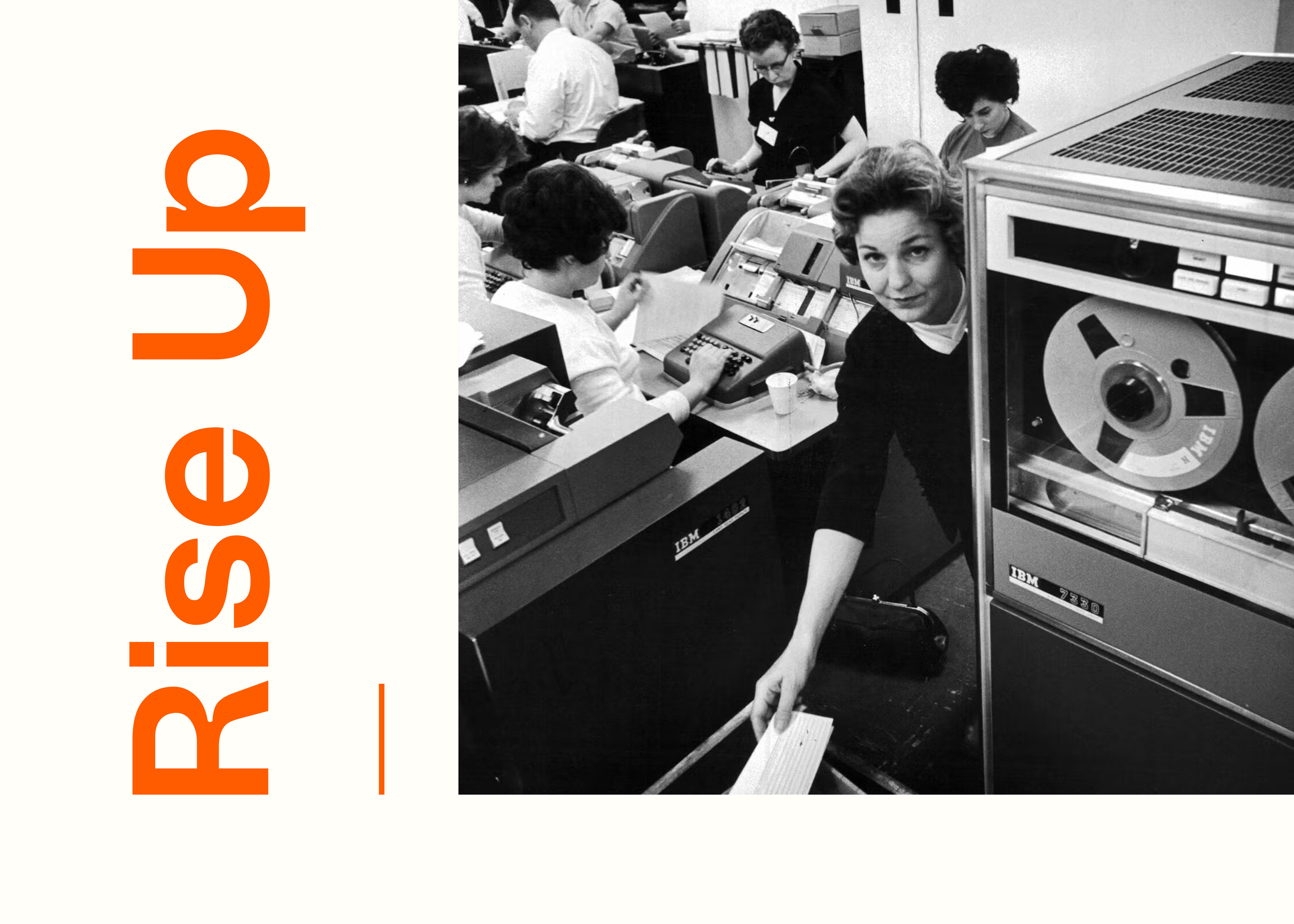
I slide it out. The cover is cream like old paper, bars of red, mustard and teal at different heights, like the punch-card holes on a Paul Rand IBM poster.
I open it, mostly to find out what it’s about.
❦
How the Simulmatics Corporation invented the future.
A true story.
Meet Ed.
Ed Greenfield, Greenfield & Co., 501 Madison Avenue.
Thick wavy black hair, wide shoulders, bespoke suits, Pall Malls, Scotch in crystal, a press-relations huckster with big ideas, big ideals, and a big rolodex.
A ten-million-volt Looney Tunes electric magnet, a giant red-handled iron U that pulled everyone toward him, plink, plink, plink.
It’s the middle of last century.
Ed is a lifelong Democrat, and lobbyist. Recommended by John F. Kennedy’s man on civil rights to Martin Luther King as “a very astute public relations man.”
Ed married Patty Safford in 1951.
Patty was a pianist and dancer who’d studied with Martha Graham; a Freudian analyst for a mother, a neurosurgeon for a father.
Patty was: Very smart and very pretty and sometimes terribly sad.
❦
I Like Ike.
Not that long ago, crowds had stood on midtown sidewalks, blocking traffic, to watch the news on wooden television sets displayed in store windows.
But by 1952, election night, the sets were in people’s homes. 15.3 million of them, 32 per cent of households.
People kept watching them. The ads. Between the programs, twenty seconds at a time. Disney-style cartoons of little men marching on Washington singing, I like Ike, I like Ike.
Rosser Reeves of ad agency Ted Bates who directed the spots, forty of them in a single day, said he saw the voter in the booth “as if he were pausing between competing tubes of toothpaste in a drugstore.”
And that night, Dwight D. Eisenhower, Ike, was leading.
00 to 1.
CBS, live on-air, the star turn was a UNIVAC, made by Remington Rand, the typewriter people. They’d paid money to put it on television in the hope of selling a few.
The actual machine was in Philadelphia, an 8-ton beast the size of a single car garage, 5,000-odd vacuum tubes, using mercury tanks for memory. What viewers saw in the New York studio was a prop: a panel embedded with blinking fairy lights, desk-sized, with a keyboard.
At 8:30pm Eastern, UNIVAC counted 3,398,745 votes and compared the data against past elections, giving Eisenhower a hundred to one, a landslide win.
On the printout, the odds read 00 to 1. The programmers had only put two digits in the output field. Nobody ever imagined it would need a third.
Since every poll thought the race was way closer, UNIVAC’s numbers were never reported.
After midnight the salesman from Remington Rand came on air, all hail UNIVAC:
“It was right. We were wrong. Next year we’ll believe it.”
❦
The People Machine.
The Democrats lost again to Ike in 1956.
Ed’s team had done “depth studies”, going into people’s houses doing research, that kind of thing.
Ed had already met a sociologist who had demo’d the first computer simulation modelling political voting patterns.
What if you could feed everything people were saying into that model to accurately predict everything they’d all do next?
The first man shown the proposals, a lawyer, wrote back that such a thing “(a) cannot work, (b) is immoral, (c) should be declared illegal.”
Ed said what they always say:
“All that machines do is provide more data to more people more quickly than otherwise.”
Ed’s people magnet went on. Mathematicians, behavioural scientists, computer scientists, plink, plink, plink.
They all went out to Patty’s family place on Long Island Sound, wives, children and dogs in tow.
The kids sailed Sunfish, chased a poodle called Sputnik up and down the sand. They sun-burned so badly their mothers had to douse them in vinegar at night.
The team worked under a giant geodesic dome that Buckminster Fuller had built nearby, complete with triangular windows over the water and a honeycombed inside, like a spaceship.
He called the company Simulmatics.
Simulation plus automatic; he hoped the term would catch on like ‘cybernetics’.
By late 1960, Ed had pitched a confidential proposal to the inner circles of the Democratic Party. On track for a third loss, John F. Kennedy was running six points behind Richard Nixon.
Simulmatics gave Kennedy’s team three moves, derived from a hundred thousand interviews sorted into 480 kinds of voter. One move was obvious: the black vote. Gallup didn’t count black people.
On 8 November 1960, Kennedy won by two-tenths of a point.
Harper’s ran a headline about the “People-Machine” and the wires picked it up: “Did IBM Computer Draft Strategy Send Kennedy To The White House?”
Kennedy’s campaign office denied everything. Ed was delighted. The best publicity a PR could hope for.
The company went public, $2 a share.
New Business.
Next, Simulmatics sold Media-Mix, a way of pre-testing a marketing campaign before it ran. Philip Morris, Procter & Gamble, Quaker Oats, Anheuser-Busch, Colgate-Palmolive, Lever Brothers. Most of them bought it.
Who was Simulmatics’ biggest client in the end?
War.
By 1967, seven dollars in ten came from the Pentagon, for Vietnam.
Simulmatics sold Washington a metric: the share of rural hamlets that were “secure” worked out from 12,500 interviews in 44 provincial capitals. That number rising month on month is how the government told itself, and the press, that America was winning.
Apparently in 1967 it was.
But, on the night of 30 January 1968, 77,000 Vietcong and North Vietnamese troops attacked more than a hundred towns and cities at once, 36 of those 44 capitals among them, then they blew a hole in the wall of the American embassy in Saigon.
The Pentagon never hired Simulmatics again.
❦
Patty.
By then, overworked and distracted, Ed had already left Patty and their three children. Well sort of. He came back only briefly to get Patty pregnant a fourth time.
Now his boy, sixteen, was away at school, and the three girls — fourteen, thirteen, and not yet four — lived at home with their mum, in Manhattan, West 22nd Street.
One night three weeks after Robert Kennedy was shot, Ed was supposed to meet Patty and the kids at the house.
He never turned up.
Patty drank alone and went up to bed, on the second floor.
During the night she walked out onto the bedroom’s balcony, and somehow off it.
Landed face down in the garden, brain bleeding.
The next morning, the girls getting ready for school assumed mummy was asleep, the dog, Chutney, was barking, but dogs do that.
Patty wasn’t found until the afternoon, died a day later. 40 years old. Ruled an accident.
A lot of people, including Ed, blamed Ed.
After that the children went to live with friends.
And Ed lived in the dark. A room in the city, where he kept the lights off, full of cartons of Pall Mall and bottles of scotch.
Man of the Year.
Wednesday, 26 August 1970, Simulmatics filed for bankruptcy in a Manhattan court.
It was the same day fifty thousand women marched for equality just a few blocks away.
“I’m going to do this again,” Ed would say. “It would be so much easier now”. He was right. There was so much more data; nobody could stop him just taking it.
No more “studies”; Ed wanted to monitor people, day by day, moment by moment, keeping track of their every feeling. Sell those feelings to the highest bidders.
He called it The Mood Corporation.
In January 1983, Time gave its Man of the Year cover to the computer. That July, aged 56, Ed had a heart attack and died.
❦
Ed never got to build The Mood Corporation. But.
The fantasy of predicting human behavior by way of machines did not die.
Facebook, Palantir, Cambridge Analytica, Amazon, Google, the Internet Research Agency, Instagram, ChatGPT, Claude, TikTok.
Take your pick.
Whether they predict us, or just keep us scrolling ads, I’ve stopped being able to tell.
By Tuesday, America’s political parties will have spent $11.6 billion on ads for the midterms. More than any election in history.
Still choosing between tubes of toothpaste.
We can lie down in the warm glow of the Mood Corporations. We can automate one set of bullshit jobs into the next set of bullshit jobs.
And yet, with zettabytes of data, and server farms the size of towns, we can’t predict much that matters at all. A pandemic. A wildfire. A riot. Which of the people you love most will be gone in six months.
The latest machine is just the latest machine: one more best guess in a universe we understand about as well as a fly understands glass.
Forget prediction. Manipulation.
Then, now.
Jill Lepore seems clear we’ve been left:
Deprived of senses, sold and bought, connected and disconnected, alienated and coerced, confused, misinformed and even governed.
Still. Ed and the scientists under that geodesic dome on Long Island Sound were hoping they could make things better, set people free, end the chaos.
They never meant to hurt anyone.
When I picture Ed, I see a Mad Man.
I’ve worked with dozens of him. The big ideals. The big ideas. The big hearts.
Underneath it all they just want to be believed.
And while Ed was out, year after year, convincing everyone that a machine could tell how people were feeling, Patty was at home, sometimes terribly sad.
❦
1:45am. Ping.
Screen Time Request. Zachary asked for more time.
Huh. I hit my allowance two hours ago, he’s clearly still been using his.
Feet on the stairs. Floorboards creak.
And there he is in the open doorway, tall and slender, all shadow. A miracle, really.
My lamp’s on, but its light stops short of the door. He tiptoes in anyway. An arm reaches slowly out of the dark for my phone, to approve his own request, because Dad’s asleep.
Dad is not asleep.
I wait until his fingers reach the screen, then my hand shoots out from under the duvet and clamps round his wrist.
Nice try, buster. What the blazes are you doing awake?
At 11:54 it was fuck you, Zachary. Now apparently, it’s blazes.
Blazes? he says.
It starts as a huh-ha, checking if he’s allowed.
Then his eyes squeeze shut, no sound comes out, and his head drops onto the duvet. Laughter blasts out of him.
I’m gone too.
A ha ha ha ha ha ha ha ha ha ha.
Both of us snorting through our noses, like two boys at the back of assembly.
He’s collapsed onto me. Somewhere in it my arms go round him. Hugs aren’t usually available these days. I take this one.
A make-good found.
Then I pat his back.
Bed, buster.
Ok, UNC.
He clumps his way back up to the second floor. Halfway, one of us says blazes and we’re off again.
Blazes, BLAZES.
Blazes!
Night, Dad.
Lamp off.
I lie there.
Patty, lying in the garden on West 22nd Street, bleeding. Her girls getting ready for school inside, thinking Mummy was still upstairs asleep.
Then, as I drift, it’s Zachary. Opposite him over a burger. Next to him in the car. Walking down a street. His hand on me, earlier.
The phone’s still lit in my hand, asking.
Approve for 15 minutes. Approve for an hour. Approve all day.
I’m asleep before I pick.
Phone on my face.
♥
Markets
Follow US mid-term results here | BBC
US economic growth accelerates in third quarter of 2026 | Reuters
Budget fails to address fiscal drag | Financial Times
Brands
World’s biggest brands are cutting advertising spend as share of sales | Marketing Week
Advertisers pull Meta ads after unwanted AI makeovers backfire | Adweek
Is AI face the new Instagram face? | Vogue
Parents worry YouTubers bring ‘brain rot’ to Netflix as kids reject ‘slop’ | The Guardian
New streaming platform aims to fix broken kids’ content landscape | Wired
Coca-Cola overhauls marketing strategy with major agency roster changes | Marketing Dive
Coca-Cola don’t let brand love be your guide | Department of Creative Affairs
How Coke loosened Pepsi’s grip on KFC’s soda fountains | The Wall Street Journal
Kathryn Turner: the M&S food boss turned social media star | The Times
How ‘workfluencers’ became the new breed of content creator | Financial Times
The rise of the IRL influencer | The Atlantic
YouTube’s long-form content strategy is winning back major brands | Vogue
Why branded entertainment fails to capture audiences and how to fix it | Adweek
Meta takes down bestselling author’s content in moderation dispute | The Times
Jaguar wasted a golden opportunity with its new electric car | The Telegraph
Five principles that separate elite CPG brand builders from competitors | Inc.
How to respond to the ‘Gen Z’ stare without looking like a total boomer | CNN
Startups
Pip and Nut appoints bankers to explore £100m sale | The Times
Why most new CPG brands fail to reach $10M in revenue | Inc.
Whop raises $205M at $5.1B valuation as Sequoia reverses pass | TechFundingNews
Liquid Death shares first-time tips for new brand collaborators | More About Advertising
Gummies are out. New craze: supplement strips | The Wall Street Journal
KIND Snacks founder invests $62 million in nasal strip startup | Entrepreneur
Tech
OpenAI pitches brands on ads alongside AI-generated images in ChatGPT | Ad Age
Beyond AI and superintelligence: what we’re actually building | Fast Company
Cookie Monster grapples with his artificial intelligence mandate | The New Yorker
Marissa Mayer on AI assistants and women in tech | The New York Times
LinkedIn takes action against AI-generated posts on platform | CNN
Why companies should consider automating their expensive CEOs | New Statesman
Lovable’s employee share sale signals confidence in startup growth | Sifted
Why Elizabeth Holmes remains impossible to ignore | The New York Times
Money
PepsiCo slashes Poppi valuation as growth momentum slows | Investing.com
Barilla acquires Goodles for $750 million in all-cash deal | Bloomberg
Unilever sells colorful bandage brand Welly to private-equity firm | The Wall Street Journal
If your CFO is asking marketing these questions, it’s probably too late | The Drum
Stop learning to speak the language of the CFO | Marketing Week
Elizabeth Holmes documentary opens with record $15 million weekend | The Guardian
Design
How Apple Music used real sound to create its new visual identity | It’s Nice That
Getty Images files for US bankruptcy, advances restructuring plan | Reuters
Clipart Studio lets you make digital collages from vintage magazines | Fast Company
Century-old Seattle beach house gets vibrant color and playful patterns | Design Milk
Happiness
Large language models overestimate human happiness compared to humans | Nature
Philosopher argues we should make ourselves, not find ourselves | Big Think
Women are fantasizing about love with objects instead of men | The Cut
If someone came to mind while you were reading, send it to them. That’s my whole marketing plan.
Stay gold 🙏🏻