


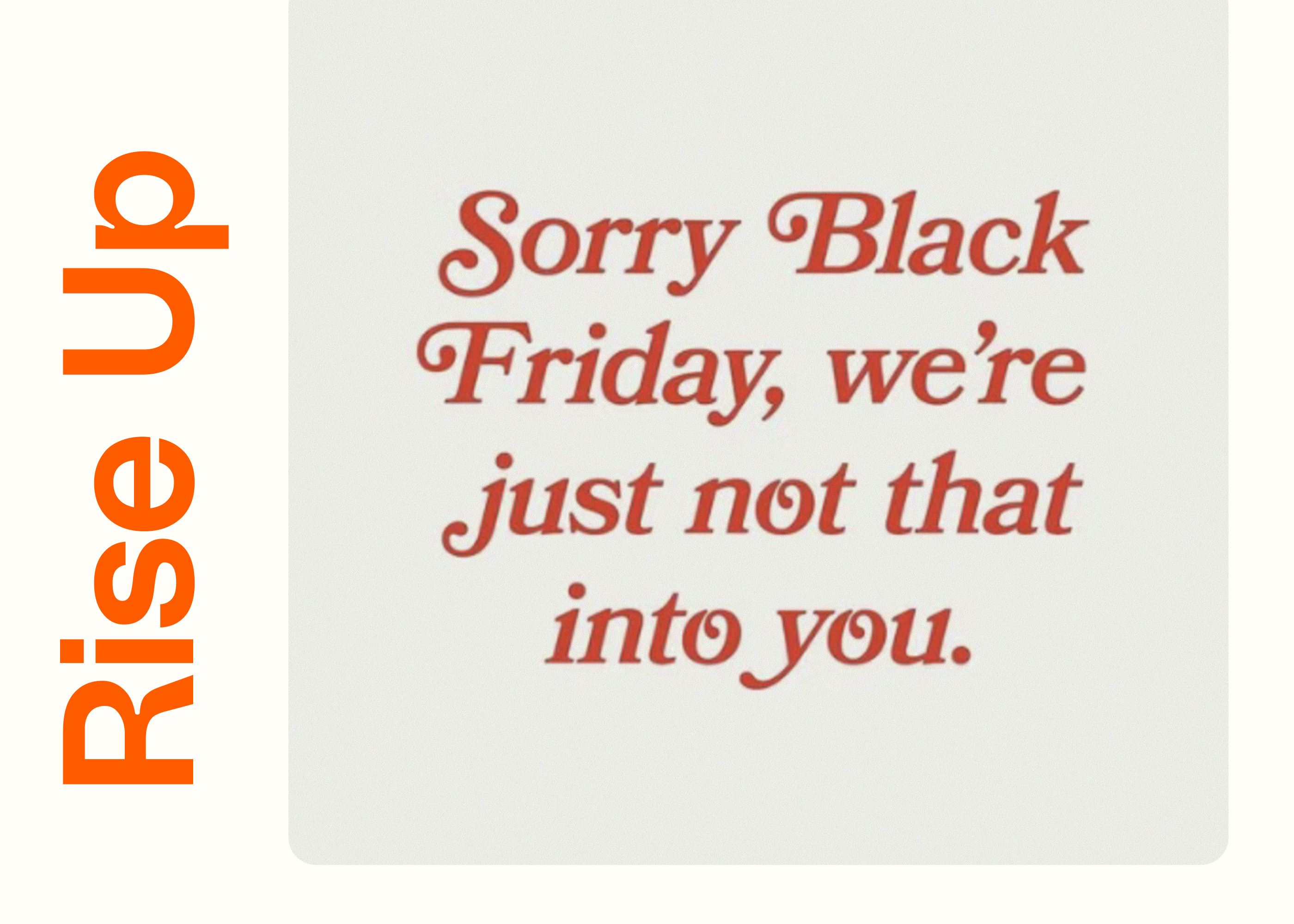
Weekly Exhale
Black Friday results are in, and what do we see? A flattening.
Sure, it still scans as the biggest sales peak of the year. It’s still the moment retailers go from loss to profit. From the red to the black. Hopefully.
But ask around and most people can’t tell you when Black Friday even is. Fact: half as many consider Black Friday the starting gun to Christmas shopping as did this time last year. Shoppers are now scattered across weeks, some starting in October, others waiting until December.
Which leaves marketers with a problem: how do you make your brand cut through when it’s all just blurred into one long pre-Christmas promotional haze?
Answer: You don’t.
So, despite being the most important moment of the retail calendar, yada, yada, Black Friday campaigns settled into one of two copy-paste options this year.
First, the apology ad.
To understand this, you need to know that nothing drives engagement like a good corporate mea culpa. The algorithm loves an apology.
This year’s brand “crises” have trained us well. Southwest Airlines. American Eagle. Cracker Barrel. Lululemon. Sonos. The “we hear you” reaction statement is now a meme. And because viral outrage is now largely performative, brands can bank the gains.
Campbell’s Soup executive caught on tape saying they “sell sh*t to f*cking poor people”? That’ll drive more brand relevance than the last twenty years of ad campaigns combined.
The Black Friday apology ads are like bad comedy sketches on the above. Brands pretending to apologise for having offers. “We just couldn’t help ourselves, sorry for any joy this may cause.”
The irony is supposed to tickle the algorithm. The sorry-not-sorry format lets them seem knowing, detached, above it all, while still desperately slashing prices like everyone else.
Second, the conscientious objection.
This is where brands throw up the peace signs instead of the promo banners. Black Friday is wrong. Think before you buy. The climate crisis won’t wait. We’re all complicit in a system of overconsumption. Stores close for the day. You get told to go outside and hug trees. Some even raise prices and donate the difference to sustainable causes.
It’s basically the Patagonia playbook, except these brands will happily sell you whatever you want, however much you want, on literally any other day of the year. Just not today.
Sort of like a bartender who’ll pour you doubles every night of the week but suddenly grows a conscience when it comes to happy hour.
So how did this stuff actually perform, and where does that leave Black Friday?
U.S. e-commerce hit $11.8 billion, up 9.1%. The U.K. spent roughly £3.8 billion, a 4.6% increase. Even with inflation factored in, Black Friday is still huge.
But store footfall? Flat.
It’s the same old story: physical retail keeps losing to the screen. Customers sit there with twelve tabs open, playing one off the other. This year, AI-powered searches took an even bigger slice, and those searches convert better than anything else.
But AI has a much better trick coming: year-round dynamic pricing.
We hate it now—airlines, Uber, the price jumping every time you refresh. But it’s early days. As the technology improves, it’ll know what you’ll pay at any given moment. Better than you know yourself.
Which takes retailers back to the 19th century, before price tags existed. Back when shopkeepers looked at who walked through the door and decided what to charge based on who they were, how they looked, and how desperate they seemed.
For now, seasonal promotions are becoming exactly what they look like: generic, routine, defensive. A margin-eroding scramble where the numbers are big, but the wins are few.
It is the day after Black Friday, and the only thing my son wants is a plectrum. I need it just as badly. That tiny sliver of plastic so we can play guitar for half an hour like I’ve promised.
I haven’t been around much lately. Made the promise on Tuesday when the weekend was far away. Now it’s here, there’s everything else. Things I need to catch up on. Things piling up.
“You said Saturday,” he pleads, desperate to believe.
I reach for an excuse. Almost. But the pile of broken promises is already too high. I can’t reach up far enough this time.
I exhale hard.
“Fine,” I say. “Let’s do it.”
He bolts. Guitar. Amp. Jack cable. Power cable. Amp on. Hum. Guitar strap. Over his shoulder. Adjusting. Ready.
Then we both freeze.
No plectrum.
Silence.
The. Smallest. Of. Things.
“It was right here,” he says.
“Well, it’s not now, is it?” I bark.
My tone is cruel. He just looks at me. Shame floods in quicker than I can take it back.
We try the usual spots. Amazon can’t deliver for a week. The big-box stores don’t have that kind of thing.
There is this one place. But I don’t hold hope.
I figure we’d better try.
We tuck ourselves down a side street off Shepherd’s Bush, past the market. I’d walked past this place a lot of times in a past life. Real keys-on-hooks shop. It was always impossible to tell if it was ever open. Dusty window, faded Fender Authorised Dealer sticker, security railings with orange rust.
I push on the front door. Metal handle. Cold. To my mild disbelief, it clanks open. Bell rings.
Inside it smells like solder and ferric oxide. Random tube amps stacked in corners, compressors with peeling labels, a vintage drum machine half-buried under curled up cables. Equipment everywhere, no logic to it.
And then, there, under the glass counter, a small wooden box full of plectrums.
I can’t believe it.
“Just need a few picks,” I say.
“Take your time,” the man says.
Late sixties maybe. Hoodie over a collared shirt. He looks like the kind of guy who’d loaded out a thousand venues. I notice a near-finished bottle of rum behind the counter. Sailor Jerry. Next to it, a tea mug stained at the rim. Maybe he’s poured a shot in.
My son hovers over the tray, picking carefully. He chooses six: a bright red, a tortoiseshell, one with a skull, two anonymous blacks, and a neon green.
“That’s five pounds,” the man says.
I reach for my wallet. I only have American Express. I’m a fool.
“Ah. No dice. Sorry mate.”
“Of course,” I say, reeling in the awkwardness. I can buy anything except what matters most right now.
The man looks at my son, smiles. “You play?”
My son nods.
“Keep ‘em then,” he said. “Musician to musician.”
I turned to my son. “That’s so kind.”
The relief is... immediate.
“We’ll get some cash,” I said to the man. “Come back properly.”
He nodded. “I’ll be here.”
All week, I kept seeing the slight nod he gave my son when he said musician to musician. Hand pressed briefly to his chest. Like he’d done this before. Handed over the right thing to the right player at the right moment.
So, the next Saturday morning, we went back.
We brought a bottle of decent dark rum — not Sailor Jerry. A thank you. And a crisp five-pound note in a simple card, a fresh open envelope, because that felt right. My son walked in holding both.
“Thank you for the plectrums,” he said, placing the bottle on the counter. “And here’s the five pounds.”
The man blinked.
“Well,” he said, trying to hand the money back. “That’s… that’s very... kind.”
“We made a deal,” my son announces. A lump swells in my throat. A deal we’re keeping.
The man looked at the rum. Nodded once, slow. “Good choice.”
Then he turned to my son.
“You wanna try something loud?”
He fired up a vintage Marshall — the kind you feel in your guts — and handed over an old Epiphone. My son hit a few awful notes that screamed off the walls.
I shake my head, like we’re about to get thrown out. But the man’s already grinning, leaning back against the counter like he’s exactly where he wants to be.
“Make a lot of noise first,” he says, nodding toward my son, “find the notes after.”
Then, almost to himself:
“That’s what Ronnie used to say. It worked for him.”
He glances at me. A beat.
I caught it.
That’s when I noticed it. A small frame. Propped against the back of the Marshall, half-hidden by a pack of strings. Easy to miss. I had to look twice. Sun-faded, slightly askew. But it was Ronnie Wood, unmistakable, arm slung around someone who looked suspiciously like the man standing in front of us, just twenty years younger, clearer-eyed.
I didn’t ask.
We all shook hands, the kind that said: We’re good here today.
“Merry Christmas,” the man said.
On the way home, my son didn’t say much. Just looked out the window, one hand in his coat pocket, still curled around those plectrums. They never left him after that. Right pocket. Always.
Later that night, I hovered in his doorway longer than I meant to.
“I shouldn’t have shouted,” I said.
He didn’t look up. Just kept fiddling with the zip on his guitar bag.
“It’s not okay,” he said.
I nodded.
“But,” he added, mumbling now, “you turned it around.”
I stood there for a second, trying to find the words. There weren’t any good ones. So I just said:
“I’ll do better.”
And I meant it. With everything I had.
Let’s rise together with every issue. ♡
Market Moves
Key takeaways from budget day | Financial Times
Consumer confidence falls to April low amid job concerns | CNBC
US economy at its most dangerous point yet | The Telegraph
Brand Beat
Fake brand apologies flood Instagram just before Black Friday | Digiday
Why Black Friday is dying and what’s replacing it | Quartz
I just don’t get Black Friday | The Wall Street Journal
U.S. Black Friday sales climb despite tariffs and economic woes | The New York Times
Who came out ahead—and who fell short—on Black Friday 2025 | Retail Dive
New York cracks down on personalized pricing with new law | TechCrunch
Ads from Nike, Lacoste and Superdry banned for greenwashing | Financial Times
American Eagle’s celebrity-led campaigns boost sales growth | Marketing Dive
British ad agencies scramble to stay ahead of technology | The Observer
American customers are angrier than they’ve ever been | The Wall Street Journal
Lawsuit: Campbell’s Soup exec called products ‘poor people’ food | The Guardian
Target needs more than a vibe shift to revive growth | Bloomberg
Lululemon founder and CEO locked in power struggle | The Wall Street Journal
Disneyland’s plan to get everyone off their phones| SFGate
Christmas ads leave viewers feeling cold and disconnected | Fashion Network
Brands flood Instagram with empty apology statements | Modern Retail
What marketers need to know about this year’s budget | Marketing Week
Which social media platform tops TikTok and X? | Fast Company
Behind Snowflake’s marketing: CMO Denise Persson’s approach | Brand Innovators
Why American Eagle hired Martha Stewart to attract older shoppers | Marketing Dive
Apple’s new all-puppet holiday ad is great | Vice
Brands scramble as “GEO” gurus rush to AI search | Business Insider
Are brands neglecting storytelling’s power to engage audiences? | Creative Review
Marketers can’t define insights; consumers couldn’t care less | The Drum
Pop-Tarts sacrifices its mascots again with over-the-top stunts | Fast Company
Sonos CEO’s Threads responses offer leadership lessons | Inc.
Omnicom closes $13B IPG deal to unite rivals | Adweek
Daily Mail owner seals £500m purchase of Telegraph titles | The Guardian
Marketers explain why they left corporate brands for sports | The Wall Street Journal
Netflix reportedly closes in on Warner Bros deal | BBC
Warner Music inks AI deal with Suno, resolves lawsuit | TechCrunch
Every 2026 trend report for consumer brands | Laurent Francoi
Starting Up
How Oddbox’s founder reshaped her wonky business | The Times
UK innovation agency names new CEO | Sifted
Startups are using robots and synth-pop to announce funding rounds | Sifted
Candy Kittens owner to acquire Unilever’s Graze snack brand | Sky News
Supabase hits $5B valuation by rejecting million-dollar contracts | TechCrunch
Tech Tidbits
Meta’s and its Enron style-accounting | Wall Street Journal
Jony Ive’s secretive OpenAI gadget redefines tech’s vibe | Fortune
Gartner predicts 50% of workplaces will abandon AI plans | Gartner
Resisting big tech’s bid for our affection | The Observer
How one writer dared to expose Silicon Valley’s flaws | The New York Times
Jeff Bezos’s AI venture acquires agentic computing startup | Wired
Venture Vibes
VC firm investigates alleged Nazi salute incident | Sifted
Monogram closes $350M consumer fund | PR Newswire
Interview with Masha Busha of Day One ventures | TechCrunch
Design Driven
Canva gears up for a likely imminent IPO | Bloomberg
Is judging a book by its cover now excessive? | It’s Nice That
How rubberhose design and algorithms are flattening culture | LBB Online
Happiness
James Patterson’s maxims for a happy life | The Atlantic
The hidden costs of making therapy a pop culture trend | Big Think
Made by hand, mind and heart. If you like what you’ve read, do subscribe and share.
Stay gold 🙏🏻