


Weekly Exhale
The Super Bowl is less than 0.2% of America’s total annual advertising spend. It’s a titchy orange ember in the cold grey ash of linear television media. But it’s making more money than ever. Over the last forty years, viewers have grown modestly from 77 million to 125 million, up 65%. But the price of a 30 second spot, well, that’s gone from $350,000 to over $8 million.
Up 2,186%.
That anyone still shows up to watch at all — the President declared the half-time show an affront to the greatness of America — says a lot about what’s left.
One observer posted: It’s the only holiday where the main activity is collectively sitting on a couch, eating melted cheese, and yelling at a screen with people you only see at weddings.
125 million people watching the same thing at the same time just doesn’t happen any more. When it does, you’re gonna pay for it. And hope you can make it work.
Older brands still deploy the Super Bowl as the last relic of advertising monoculture. A way of defending the brand castle the good-old-fashioned way.
Newer brands do it for a different reason. The cost per mille makes no sense, I mean why would it, the reach is a rounding error against digital, but then again it makes perfect sense because what they’re actually buying is something else entirely:
Legitimacy.
A Super Bowl spot puts you in front of everybody. But the real prize is that it justifies the full machinery. The salmon pages, broadcast, the prestige business mastheads — they all still cover it. Forget ring-lights and hot takes where everything is “iconic” for two swipes. This is chance to flex in front of the older, saltier class of journalist with longer memories, longer reputations and longer podcasts.
The kind who move markets.
Given that, most brands miss their shot.
Too many celebrities, too much saving the world, nostalgia bait, all the usual tricks. Humour is good. But even the good ad jokes give you whiplash as soon as the logo comes up. The link back to the brand is weak, so they get a few confused mentions in the round ups, and do a few LinkedIn victory laps. Then they’re gone.
Half never return.
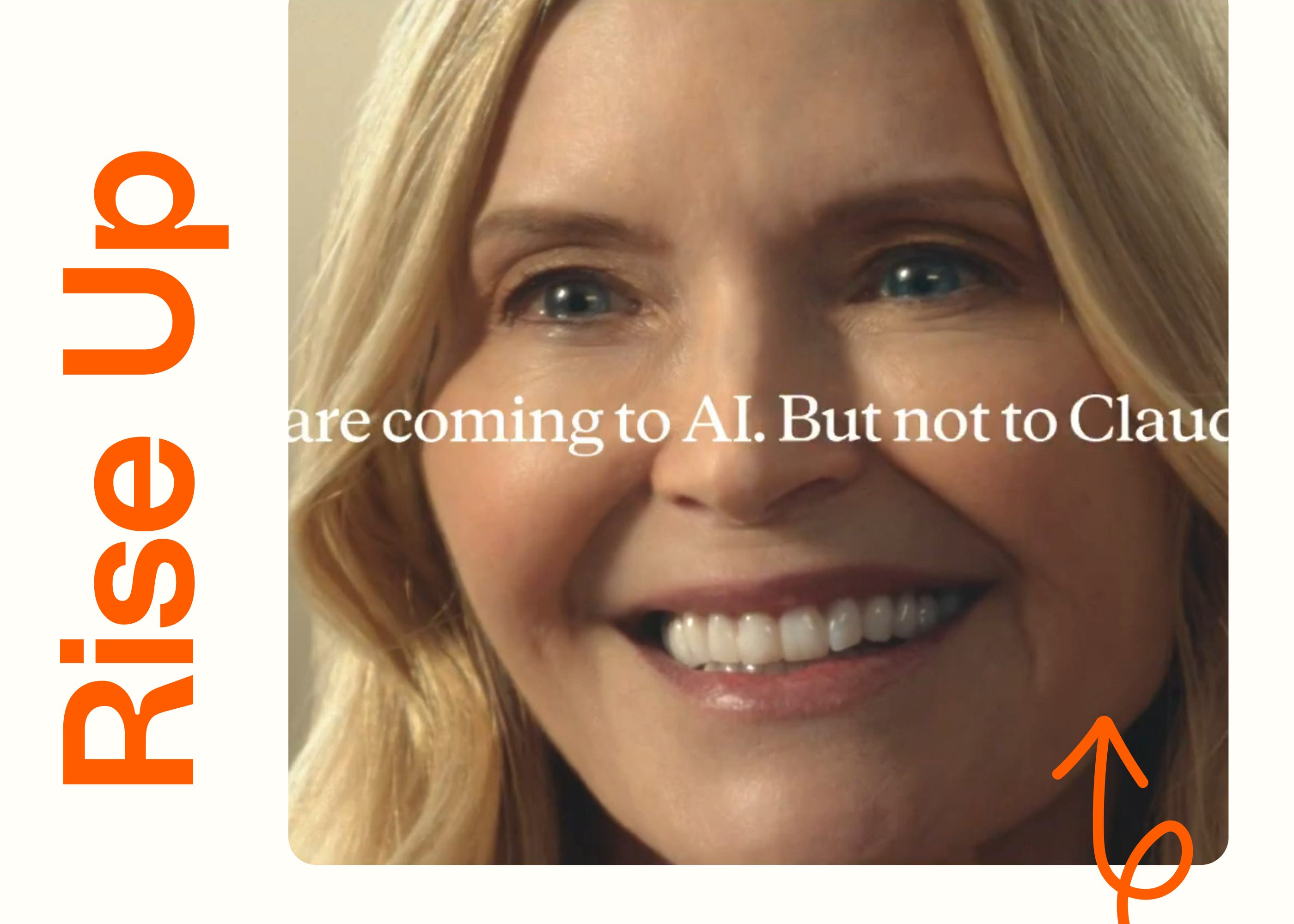
Anthropic didn’t miss.
Whipsmart. The work, by any ad veteran’s standards, is good. Which by today’s makes it exceptional. Like new money walking into an old room and showing them how it’s done.
Four spots and a truth well spun: AI that serves ads can’t serve you.
BETRAYAL. VIOLATION. TREACHERY. DECEPTION — the titles of four intimate AI conversations, each one derailing into a jarring, hilariously inappropriate sales pitch.
A nervous entrepreneur sharing her business idea gets sold a payday loan. A man asking for help talking to his mother gets “Golden Encounters,” a cougar-dating site.
Over endframe, Dr Dre’s “What’s the Difference” chimes in like a taunt.
For Anthropic’s founders—who defected from OpenAI five and a half years ago—there’s really only one way to read it:
Hey, go f**k yourself, Sam Altman.
Who, in turn, couldn’t help himself. He fired back within hours. Got all defensive about OpenAI’s users and called Anthropic “authoritarian”. Then he kept posting. Like Pringles, once he popped, he couldn’t stop.
In the end the ads didn’t need to say much, because Sam’s reaction said it all. The campaign hadn’t even run yet, and Anthropic already had all the airtime it needed.
Marketers’ heads exploded with the affirmation.
This was a Ries and Trout masterclass — brand positioning by de-positioning another.
And to be fair, in the battle for your mind, Anthropic barely threw a punch. More like a judo throw. A $350 billion company using the weight of an $830 billion rival to slam it face down on the mat, blood everywhere.
But this stuff doesn’t come from brand strategy. It comes from instinct. And a little theft. Someone in the writer’s room had clearly been watching Rashida Jones in Black Mirror’s “Common People.” The playbook is stolen from further back still. Steve Jobs, smiling from the other side. 1984. The dawn of the personal computer, the AI of its time. His Charlie Brooker was George Orwell. IBM was Big Brother with Apple as the hammer through the screen.
Same with the whole AI story — the grinning chatbots, Sam’s endless techno-god musings about saving humanity — it’s all just going to end in...more advertising.
Anthropic. This is why AI won’t be like AI.
Phew. Anthropic giving us a welcome breath of rebellion, the way Apple did back then. Positive. Necessary. Something to believe in.
And it works because in their case, that breath draws from somewhere really deep.
Co-founders Dario and Daniela, brother and sister, grew up in San Francisco. Italian-Jewish family. Their father, Riccardo, was a leather craftsman trained near Elba. Their mother, Elena, a librarian. Their grandmother chained herself to the Italian embassy in Chicago in the 1930s to protest Mussolini. Conscience runs in the family.
In 2006, Riccardo, died after a long, long battle with a rare illness. Daniela was nineteen. Dario was twenty-three.
Four years later, a scientific breakthrough meant that same disease became 95% curable.
Pause on that with me for a second. Picture it.
The single biggest loving memory of your Dad, is a man slowly decaying. His hands—craftsman’s hands, leather-worker’s hands—turn cold. You stand there in a suit that doesn’t fit, collar grazing your throat. You wait your turn. Drop flowers onto the casket.
Weeks pass. You walk past a shop and catch the smell of leather and your whole chest locks. You go to call, thumb over the number. Then you remember there’s no one to pick up.
And one morning, a WhatsApp. Not even a message. Just a preview panel, sent to you maybe by a friend: A cure has been found.
And the magical thinking — that deeply painful insistence that somehow he’s still coming back — turns to something worse. Because now he actually could have. And never will.
Dario: “My father died because of cures that could have happened a few years earlier.”
December 2020. Dario and Daniela, fifteen researchers behind them, sick of the way OpenAI was going, walked out to create Anthropic: A safety-first research lab and a public benefit corporation.
Most companies, at this point in the story, would write a mission statement. Maybe a brand book. Hex codes, tone guidelines, a bunch of other stuff nobody reads.
Anthropic ended up writing something else.
“The Soul Document”, roughly 14,000 tokens, about seven times longer than a standard system prompt, compressed into the model’s weights, teaching it how to conceive of its purpose, ethics and identity.
Claude picked the name itself.
A tinkerer named Richard Weiss extracted it the day Claude 4.5 Opus launched last November, using $70 in API credits. Amanda Aksell, Anthropic’s character lead, confirmed it was real a day later.
So if you’ve downloaded Claude’s desktop app, fiddled around with co-work, you’ve felt something unusual. The design is considered. Built with the kind of care you’d recognise if your father worked with his hands. And whom you maybe still miss, painfully, every day.
Mess around with it a bit longer, and you realise it’s not just considered. It’s useful. Really useful.
So now, despite being quite a bit smaller, it seems like Anthropic might win. Regulated industries need an audit trail they can trust. That’s Anthropic. Having cornered the enterprise market, they’re worth more than eight times the revenue per user of OpenAI.
Meanwhile, every time Chitty-Chatty-ChatGPT flatters one of its 900 million weekly users into another query, OpenAI loses even more money.
There’s only one thorn.
Not that Anthropic will probably also carry ads one day and will “revise its ad policy transparently” if ever required. Not that it took $500 million from Sam Bankman-Fried’s effective altruism circus. Not even the paradox of a company sprinting towards the very things it says terrifies it.
It’s dafter than all of that.
They made ads. To tell us ads are bad. And they were the best ads of the biggest ad night of the year since forever.
We say we hate ads. But, in the end, we chose them. Everytime.
Google. YouTube. Instagram. Spotify. Netflix. Every free thing we love is paid for by the thing we say we can’t stand.
Don’t forget, in a world powered by consumerism, 95% of people can’t afford subscription fees.
Besides, ChatGPT with ads isn’t going to be Alexa barking at you, or some pop-up banner crashing a conversation. It’s going to be the most informed, most intuitive personal shopper that money can’t buy.
Meaning marketers want it..bad.
Fact: AI search is already showing up in dashboards and the early results look like advertising’s saviour.
Remember, Google looked just as vulnerable as OpenAI back in 2004. Two years later it was doing ad revenues previously unthinkable.
Then Google gave us AlphaFold — mapping the structure of virtually every known protein, Nobel Prize in 2024, arguably the most important scientific AI breakthrough of our time.
Funded entirely by Google’s ad business.
The counterfactual to the Anthropic story isn’t that OpenAI is doomed. It’s that the models built to cure diseases don’t have the free cash flow. The ones selling height-boosting insoles do.
As for who is going to win out of AI’s big bets, here’s a reminder: We don’t know. It might be Anthropic, it might be OpenAI, it might be both, it might be neither.
In the days it took to write this, OpenAI acqui-hired the creator of OpenClaw — an open-source AI agent vibe-coded by a single Austrian developer, 180,000 GitHub stars in weeks. Originally called Clawdbot, until Anthropic’s lawyers killed the name for being too close to Claude. The irony writes itself.
Meanwhile, back in Super Bowl land, turns out nobody’s heard of Black Mirror. The HarrisX viewer poll ranked Anthropic 67th out of 70. Forty-two percent found the ads confusing.
USA Today’s Ad Meter — the one that matters — gave the number one slot to Budweiser’s Clydesdales.
For the second year running.
Let’s rise together with every issue. ♡
Market Moves
UK post-pandemic unemployment high points to rate cuts | Reuters
Is the US economy as hot as Trump thinks? | Financial Times
How speculation and nostalgia became the economy | Kyla Scanlon
Brand Beat
Apple clashes with Trump amid fresh tensions | Financial Times
Why AI chatbots will soon display ads | Financial Times
Samsung floods social media with AI ads | The Verge
Brand marketing becomes 2026 focus after revenue shortfall | Digiday
AI fumbles its big Super Bowl investment | The Wall Street Journal
Super Bowl misses TV records, set social media milestone | The Guardian
Ranking the 2026 Super Bowl ads from best to worst | USA Today
Claude’s ad isn’t about Super Bowl victory—it’s playing another game | Forbes
Brands line up to test ads on ChatGPT | Adweek
Cola wars return with AI as the new battleground | Fast Company
Scottish craft brewer Brewdog goes up for sale | BBC
Vue cinemas avert liquidation after settling Coca-Cola bill | Deadline
Warner Bros. Discovery resumes Paramount deal talks | The New York Times
TED and Lego Group partner to prioritise play worldwide | Lego
J.Crew CMO on leveraging hype in hiring and branding | Feed Me
New challenger takes on Sephora | Business of Fashion
Guinness: What parenting and brand building have in common| The Drum
Puma boosts community engagement with AI co-creation platform | Glossy
Meta admits 3-4% of revenue came from scam and fraud ads | The Media Leader
UK ad agencies face record staff exodus amid AI threat | The Guardian
Key takeaways from consumer brand earnings calls, Q1 2026 | Mediacat
Starting Up
How VCs value startups | Serena’s Substack
Financial, and technical, debt shapes startup brands | Sifted
UK’s £8bn research fund pauses new grants amid tough decisions | BBC
What happens when founders buy back their companies | They Got Acquired
Tech Tidbits
OpenClaw founder moves to OpenAI | The Verge
Will OpenAI tank OpenClaw? | The Week In Startups
Airbnb’s AI search outperforms Google in conversion rates | Marketing Week
Anthropic still uncertain what Claude actually is | The New Yorker
What we protect by defending social media | MediaCat
Venture Vibes
Dave Stewart’s wants to flip VC, give power back to creators | The Drum
Masha Bucher breaks silence amid Epstein fallout | SF Standard
Mark Cuban’s surprising anti-AI investment could define 2026 | Fast Company
Kleiner Perkins was written off, then an unlikely VC swooped in | Fortune
Design Driven
‘Mexico Modern’ sparks wanderlust for Mexico’s architectural landscapes | Wallpaper
Tracey Emin reflects on smoking regrets at Tate Modern | The Guardian
Why showing your work matters more than ever | It’s Nice That
Happiness
When your loved one falls in love with an AI | The Wall Street Journal
Curiosity is at the heart of dating | Big Think
Secret to happiness has another new theory | New York Times
Written with heart and hard won wisdom. So, do share and subscribe. ♾️
Stay gold 🙏🏻