


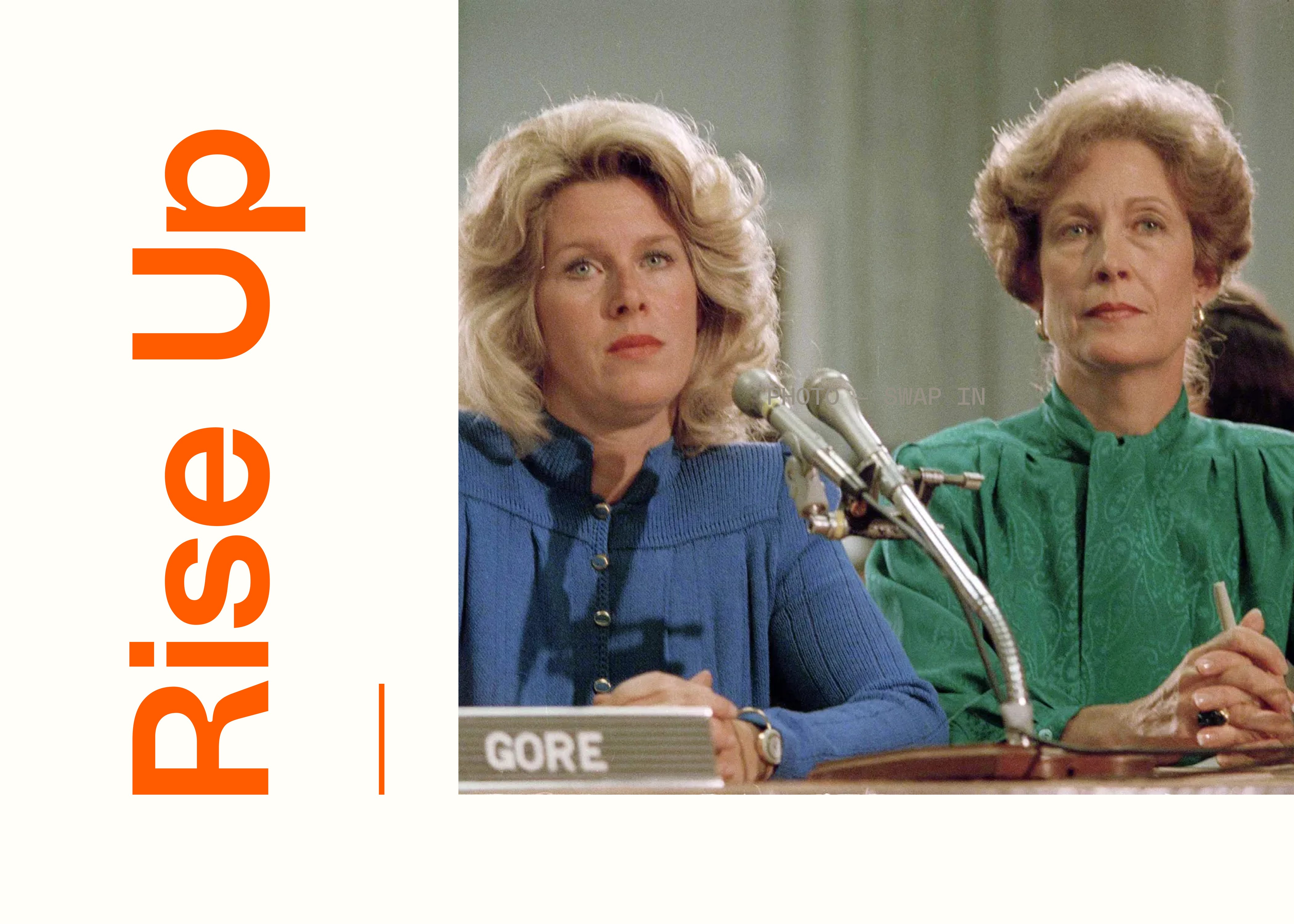
It’s 1984.
Tipper Gore and her daughter Karenna are about to rock out to Prince in the lounge of the family’s brick Tudor house on 26th Street, South Arlington. The house Tipper grew up in, built by her grandfather’s own hands.
On the mantel, a silver crucifix, a wedding photo, and a blue campaign button with three red and white stars: Tipper is married to senator-elect Al Gore.
Today, Karenna, 11, gets to work the new hi-fi herself, the expensive one, brush-silver Sony separates stacked into a tower behind the glass door of a wood-veneer cabinet.
She slides the black disc out, careful at the edges, and sets it down. First crackles, then butterflies.
Side one opens with the radio hit Let’s Go Crazy, a song about God and transcendence.
Then track five. A boxy drumbeat and simple notes as Prince begins:
I knew a girl named Nikki. I guess you could say she was a sex fiend. I met her in a hotel lobby. Masturbating with a magazine.
The song ends with rain and wind and Prince’s voice recorded in reverse, like he’s possessed. Backmasking, everyone knows, is how bands hide satanic messages in their songs to brainwash children.
Tipper gasps, then boils. “I couldn’t believe my ears,” she says later.
And now.
A special Friday night with my 13-year-old son, and I need it to be a good one. London is burning, near 40 degrees, the air-con in the restaurant has melted, we are melting with it.
We order off the phone. Fine. After that my son can’t let the device settle. Face down on the table, except it never stays face down.
He keeps reaching for it to show me things he has no words of his own for, and the second I get up for napkins he’s back on it, then he disappears to the toilet to check it, and when he returns I’m ready to grab this damn phone and hurl it through the restaurant, out into the street.
I feel my body loading up to do it.
The phone sails through the folded-back doors. I run out after it, swoop it up before it’s stopped skidding, and slam it straight back down on the ground.
Down on my knees, I slam it down, slam it down, slam it down again, and only when it’s completely shattered do I look up to the sky, palms out, and scream: WHAT IN GOD’S NAME HAPPENED TO US?
I look around. The street, the cars, the restaurant I’ve just come from, all empty.
It’s just me out there.
Except it isn’t just me.
Forty years earlier, deranged by the same helplessness, Tipper is already up off the sofa.
She rounds up three other Washington wives, and within a year they’ve marched into the Senate and forced the record companies to put warning stickers on the front of records, cassettes, and, later, compact discs.
Dee Snider, John Denver, and Frank Zappa turn up at the hearing, calling it an affront to the First Amendment.
The bigger affront is, of course, the money.
Albums are driving billions into the pockets of music labels; the cover is an advertising art form; the last thing you want on one is a government sticker.
Of all the majors asked to submit designs, Deborah Norcross, a designer at Warners, is the only one who bothers. Her work is stark, black type on white, all caps: PARENTAL ADVISORY. EXPLICIT LYRICS.
It takes five years.
The first album to wear the marque is 2 Live Crew’s “Banned in the U.S.A.“ Public Enemy, N.W.A and Ice Cube soon wear theirs with pride, and the sticker becomes the most coveted square inch in music marketing history. Anything with one outsells the others by up to 30 per cent.
Warnings, bans, guidelines, whatever the grown-ups solemnly declare never matters: Rules are meant to be broken and money is meant to be made.
Besides, if the devil really had found a way into our homes, he wasn’t hiding in the grooves of records, or behind the glass of the wood-veneer hi-fi cabinet. He was sitting in the other wooden box, the one in the middle of the front room.
Television.
Between 1950 and 1960, TV sets entered 90 per cent of American homes. That’s faster than the internet, social media, and even AI.
Families went from saying grace around a dinner table and talking about their day, to slouching on sofas, food on laps, not talking about their day.
It scared us from the start.
One of the first big studies, out of Stanford in 1961, monitored 6,000 children under the question of what the set was doing to them, with concerns over violence and criminal tendencies.
In 1977, Marie Winn wrote The Plug-In Drug, a bestseller concluding television was a surrogate babysitter that damaged growing brains.
And by 1991, Mother Jones magazine coined “screen time“, a term that never went away, as screens, bigger and smaller, filled every room in the house.
Reality TV came next.
From 2003 to 2016, America’s Next Top Model is one of the biggest shows on television, 100 million viewers, 250 hours of coercive makeovers and relentless pressure to be thinner.
Contestant Keenyah Hill says viewers have told her the way her body was discussed on that show is what started their eating disorders.
We look back on Parental Advisory stickers and smile. But we look back on Top Model and wince. Did we really call that entertainment?
Yes, we also called it empowering.
Top Model wraps in 2016; by then it has already reappeared in teens’ pockets as Instagram.
So when The Anxious Generation by Jonathan Haidt arrives in 2024, after a pandemic that schooled our children by screen, we’re ready to receive its message.
Haidt pins the rise in girls’ depression, anxiety, and suicide to the moment social media took root in their phones.
The devil finally reveals himself: the phone.
Preach, brother.
But two Oxford researchers, Amy Orben and Andrew Przybylski, had already run the numbers: Screen time all told, Top Model included, drove teenagers towards misery about as much as eating potatoes.
Candice Odgers, a UC Irvine psychologist who studies adolescence, reviewed The Anxious Generation for Nature.
She doesn’t doubt Haidt tells a compelling story.
Which is exactly the problem she has with it.
Hundreds of researchers, her included, have gone looking for Haidt’s large effects:
“Our efforts have produced a mix of no, small and mixed associations.”
Frightened parents want to put stickers on things. Truth is never so singular.
There is one thing the data does agree on.
The worst years on record for teenage suicide belong to the boys: four in five of them, 18.1 in every 100,000 at the peak, compared to 3.7 for girls.
Those worst years were 1990 to 1994.
Taking us back to music.
MTV, grunge, Kurt Cobain, and Smells Like Teen Spirit. A song that never wore one of Tipper’s advisory labels, because “load up on guns, bring your friends“ isn’t explicit profanity.
A song that was prophetic, save for the friends: it took three days before anyone found Cobain, alone, in the greenhouse above the detached garage of his home in Seattle.
…every couple generations, humanity reinvents fire. It takes a while for them to figure out how not to burn themselves but instead warm themselves…
A line Andrew Stanton, one of the original minds at Pixar, heard on the news and tried to fit into his last film. He’s also just spent years inside Toy Story 5 and its question of what happens when screens replace toys.
He’s right. It sure does take a while. And many lives.
In the meantime, you can’t tell if you’re warming or burning.
Mostly it just feels like melting.
A couple of months after Haidt’s book is published, Charli XCX’s “Brat“ is released.
Charli does a little key, a little line on one song, asks you to guess the colour of knickers on another, then tells you you can put them in your mouth.
“kamala IS brat,” Charli posts on X.
The 49th Vice President, Kamala Harris, has just begun a race to retain the White House.
Hours later: ten million views.
Kamala and her team turn the campaign’s socials and avatar slime green, Arial font, all of it borrowed from the lo-fi artwork of Charli’s new album.
Somewhere, Tipper still has Al’s 1984 blue campaign button.
It’s on the mantel of the brick Tudor on 26th Street, behind Karenna’s Harvard graduation photo, standing where the wedding photo used to be, put away since the separation, and next to the crucifix that hasn’t moved in 40 years.
The button is rusted metal and real.
She’d pick it up, turn it over once, look at the three red and white stars.
And shrug, probably.
Back in the sweltering restaurant, my son and I aren’t speaking. I study the table instead. The phone face down between us, the wet rings where the glasses were, our napkins scrunched soft.
In the calm, I look up. His thick dark hair, almond eyes, his fitted black T-shirt, a chain with a cross on it, because he saw it on TikTok.
It’s hard not to stare at this young man, at how much life there is in front of him.
And, in the same moment, I see why none of him is interested in being told anything by the man across the table, whose best years, likely, are behind him.
He gets up for his jacket, so naturally I use the chance to check up on him.
Flip the phone over, type his code, and swipe frantically through the open apps: ExpressVPN, Snapchat, Gmail, Trading212, WhatsApp, Photos, YouTube Music, Translate, ChatGPT, Messages, Monzo, Revolut, LinkedIn, Duolingo, Teams, Holy Bible, Vinted, Maps.
My mind scans them for the dangerous ones.
I decide it’s all of them.
And all of us.
Haidt’s book actually says two things. The half we pore over is about big tech, how we leave our children unprotected in the virtual world.
The other half is about us, how we over-protect them in the real one.
Maybe we missed that part looking at posts about Haidt on our phones, instead of reading the damn book, busy as we were.
Because we know we can’t sit, alone, in a room with nothing in our hands.
Because we know a screen never leaves, and people do.
Because we know, no matter how hard we love them, sometimes we lose them anyway.
“I’m fine, ‘cause I know that the Lord is coming soon.“
If Tipper had ever played Darling Nikki in reverse, she’d have found no Satan buried backwards in the track. Just the singing of a man on his knees, praying for protection.
There’s only one app I can think of that isn’t on his phone. Or mine.
Garden cricket? I say.
I hate sport. All of it: the ball, the bat, the hitting, the catching, the rummaging in a bush by faded evening light. Given the choice, I’d rather sit slumped in front of Netflix and not have to do anything at all.
But out in the warm summer air, the phones somewhere inside behind the glass, we find our way not to be alone.
He insists on one more over at 10 o’clock, and another at twenty past. I miss the ball, I lose the ball, I stand in the bush by the fence while he calls instructions, and there is nowhere on earth I would rather be.
“This is fun,” he says.
The game goes on too long, and it is fleeting.
And for every moment we’re there, he’s safe.
Let’s rise together with every issue. ♡
Market Moves
Why Gen Z struggles to find work as over-50s compete for entry-level jobs | The Times
City leaders debate who should succeed Reeves as chancellor | Financial Times
Bank of America CEO sees resilient consumer spending powering economy despite affordability pain | Axios
Brand Beat
Teenagers dismiss Britain’s social media curfew as pointless without enforcement | The Guardian
Should we build a separate, safer internet just for children? | The Verge
Nike and Adidas wage £50m World Cup advertising battle with blockbuster campaigns | BBC
World Cup’s new hydration breaks reveal deeper strategy beyond water | Wired
Reddit launches ‘People Are The Best’ campaign positioning itself as antidote to AI | MediaCat
A24 responds to backlash over Google AI collaboration announcement | Wired
Hinge founder’s $18M AI matchmaker sparks Black Mirror comparisons | Inc
Unilever shifts from agencies to creators, dismisses need for big ideas | The Drum
Nike shifts to micro-communities strategy, ditching single hero campaigns | MediaCat
Jim Stengel defends brand purpose against Sharp and Ritson’s criticism at Cannes Lions | Economic Times
Procter & Gamble brings scripted dramas to supermarket shelves | Wall Street Journal
McKinsey explores modern rethinking of marketing’s core fundamentals | McKinsey
Meta launches prediction markets app amid regulatory scrutiny | The New York Times
Comcast splits Sky and NBCUniversal into standalone media company | The Times
Sky’s ITV takeover reshapes British TV landscape amid streaming competition | The Guardian
Coca-Cola faces major legal battle with the IRS over tax dispute | Wall Street Journal
Balenciaga appoints new chief marketing officer to lead brand strategy | WWD
Hasbro targets adults with revamped Play-Doh in aging-up strategy | Wall Street Journal
Coty’s Covergirl targets Gen X women with older models and sub-$10 prices | Bloomberg
The multi-million dollar quest to create a naturally blue M&M | Wall Street Journal
Who is the MrBeast of tech and why does it matter | Sifted
An ad from 30 years ago predicted modern life, and still resonates | Entrepreneur
Starting Up
Neko Health raises $700M, valued at $7bn, expands to New York | The Next Web
Reformed closes £17m Series A funding round | The Grocer
How a two-person CPG team built a $1M revenue brand | The Food Stack
Oregon shoemaker sells business to 30 employees, sparking workplace transformation | BBC
Tech Tidbits
Why big AI labs are hiring so many philosophers | The Economist
OpenAI’s lifelike speaker sparks Apple theft allegations | Fortune
Robot dogs, Teslas, and helicopters stole the show at UN AI summit | Wired
Andy Burnham’s AI plan sparks mixed reactions across UK | Sifted
Venture Vibes
David Beckham’s IM8 health drink startup raises $1B from General Catalyst | TechCrunch
EasyJet bought by US private equity firm for $7.5bn | Telegraph
Brompton sells stakes to Decathlon and Chinese Labubu backer | The Guardian
Design Driven
Bumble’s new Aspen chalet is an inviting home, not a branded activation | Design Milk
How designers built the dream home of a tech visionary at 87 | Wired
How McDonald’s Golden Arches became the world’s most recognizable logo | Wallpaper
Happiness
How watching a soccer final affects your body | Wired
Cannabis-using mothers find community and coping in the ‘garden mom’ trend | The Atlantic
Should you date your coworkers? Here’s what to consider | The New York Times
If you like what you’ve read, do subscribe and share ♾️
Stay gold 🙏🏻