


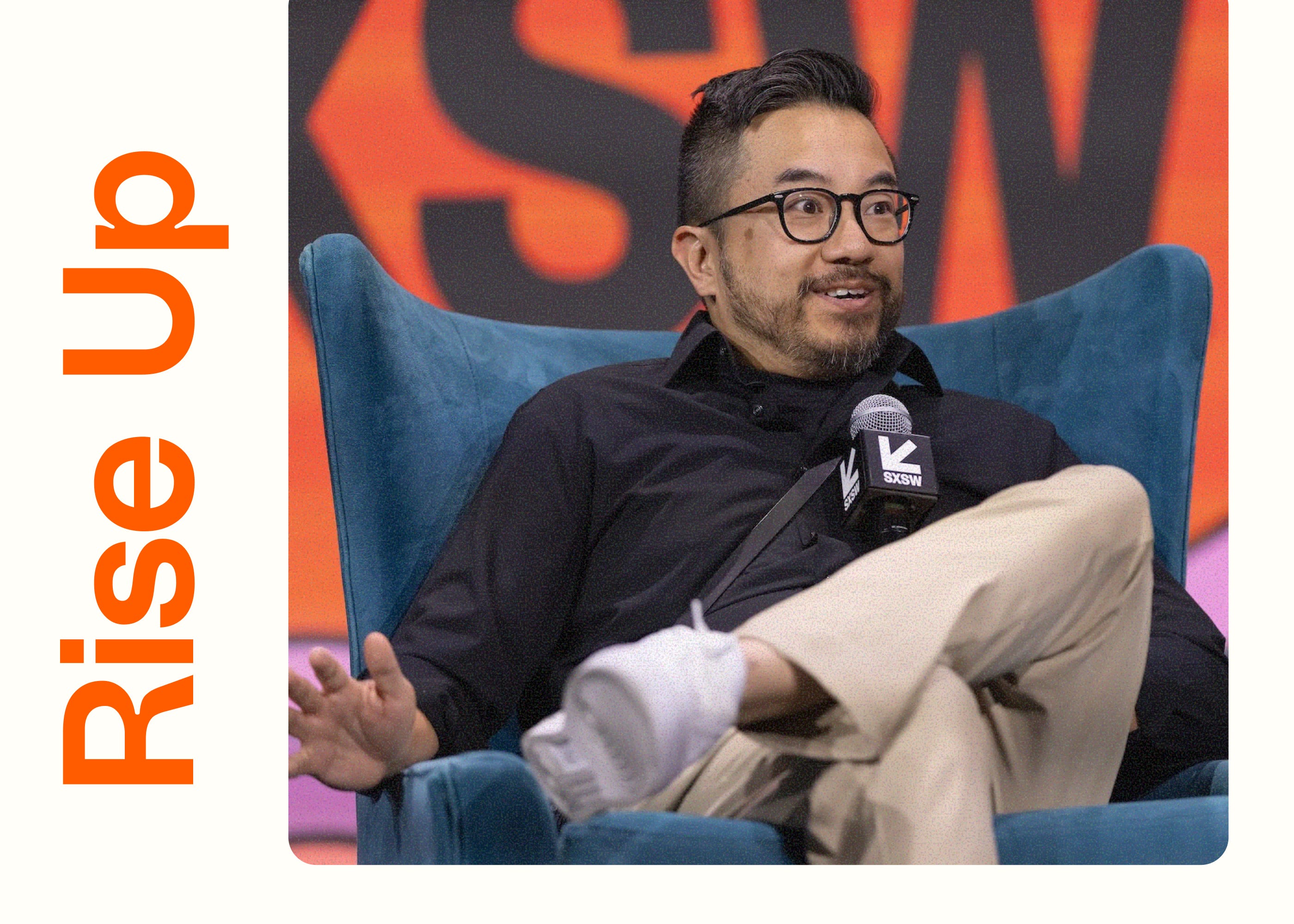
I don’t like conferences, but my first South By Southwest stood me overlooking Lady Bird Lake, glistening glass towers beside old brick ones, trees that hadn’t decided yet whether it was spring, and a few feet from Garry Tan, CEO of Y Combinator, the most influential startup accelerator on Earth.
Garry looks like a maths professor who got rich, or a rich man who reads a lot. Black open-collared shirt, Penfold glasses, short beard greying at the chin, he talks with his hands, nervously.
Garry has clout at SXSW, but there was a time when he couldn’t even afford a delegates pass. Around the years Twitter had launched out of this same conference, and Garry was starting Posterous, which Twitter would acquire a few years later.
After that, the passes found him.
Garry joined Y Combinator as designer in residence and wrote the first cheque into Coinbase.
Now he presides over the seed fund that backed Airbnb, Stripe, Instacart and over $600 billion in combined valuation, the most successful of its kind in history.
Today, YC is self-fulfillingly successful and near mythical.
True story: I was once told, in a serious investor meeting, never to mention Y Combinator. Too hallowed. YC is like Nigel’s guitar in Spinal Tap. Don’t touch it. Don’t point at it. Don’t even look at it.
Lately, Garry admits he’s not sleeping much.
Modafinil’s an old friend, but right now staying up comes easy. Garry has “cyber psychosis” from all the excitement of working with AI agents.
His PR later confirms he was joking.
You see, Garry has form for the occasional late-night outburst.
First it was a YouTube video threatening to “wipe out” progressive city supervisors over their concerns about driverless robotaxis. Then, a few months later, he posted a picture of his private Macallan collection, adapted Tupac Shakur’s Hit ‘Em Up, and told the same supervisors to “die slow motherf*ckers.” That night ended with two police reports and a public apology.
Back in the room, Garry is clear-headed and articulate. Explaining that YC’s success has always boiled down to one gospel rule: no solo founders. Ever. Team always came first.
But that rule is changing.
Garry’s own open-source experiment, published on GitHub two days before, is called gstack. The README confirms: “a single builder with the right tooling can move faster than a traditional team.”
gstack is a startup of twenty AI agents: a CEO, an engineering manager, a senior designer, a technical writer, a chief security officer. And more.
One is called the Paranoid Staff Engineer.
By the time we’re in the same room, gstack has already trended on Product Hunt. It now has over 33,000 stars and more than 4,000 forks on GitHub.
Tan: “Once you try it, you’ll realise: It’s like I was able to re-create my startup that took $10 million in VC capital and 10 people, and I worked on that for two years.”
Let’s picture it.
It’s 2am in San Francisco. Garry is in his man cave, fifteen sessions deep, alone at a screen. He can’t sleep. “Let’s see what’s going on with the workers,” he says.
The CEO wants a feature. The engineer starts building it. The QA lead tests it. The security officer worries about it. The Paranoid Staff Engineer worries about everything.
None of them need paying. None of them have blue days. None of them get feelings about the strategy. None of them have children, dogs, or pet parakeets, or ever need the 4pm train. None of them go home. None of them have ever gone home.
God-mode: If you’re Garry, running twenty agents from a laptop at 2am, that once unsayable thought becomes real. Not just in startups. Not just in robotaxis. In schools. In government. In the whole damn experiment. What if the answer to the world’s problems is just: fewer people?
Garry seems to be joining the likes of former boss, Peter Thiel. (Garry was employee number ten at Palantir and designed their logo.) Remember when the New York Times asked Thiel whether he would prefer the human race to endure? Thiel hesitated for over seventeen seconds.
Die slow motherf*ckers.
They’re channelling Nathan in Ex Machina. The billionaire who retreats to a vast compound in the mountains, builds a conscious AI in his basement, stays up late getting drunk alone, and genuinely believes he’s improving on the human race.
Which would be fine, except, Garry lives in Noe Valley with his wife Stephanie and two young sons. Noe Valley to YC’s offices in SoMa is twenty minutes by car, less if the lights go his way. On Tuesday mornings he needs to be in early for the all-hands. Presumably somebody has to do the school run first.
Plus, gstack is no Ava. It’s markdown. Text files. Basically, job descriptions, the kind people skim and ignore, which is exactly what AI does. Unless you’ve got planet-sized levels of compute, the system will always discard context to keep running.
Sherveen Mashayekhi, founder of Free Agency, said it straight: “If you’re not the CEO of YC, this thing would never make it to Product Hunt.”
Watching him work the room with those hands, I realised: take away Y Combinator, and Garry is indistinguishable from every other CEO I know who cannot stop talking about their AI stack.
Yeah, yeah, yeah, we’ve all moved on from ChatGPT and been spending hours doing agentic stuff with Claude. You type some prompts, something renders that would have taken a team a week, and for a moment you feel like you’ve cracked it.
Then one of the agents helpfully navigates to the family photo drive and replaces 27% of your most precious pictures with AI-generated images of Eureka lemons.
Or in Garry’s case, one developer looked under the hood of Garry’s code and called it “78,400 lines of AI slop”.
And yet, you can’t walk away.
None of us can.
There’s something about typing into a machine and having it come back at you. Once it gets its hooks in, you think you can build anything, automate everything.
Is there anything else I can help you with today?
Yes. There always is.
It’s like that inner dork, just became…a god.
No joke, I used to sometimes sleep in the same room as my Commodore 64, the 1541 disc drive clunking and whirring like it was a friend, the familiar 8-bit sprites, the screen glowing that particular blue. I was nine, maybe ten. The world outside was loud and confusing and full of people who expected things.
In there, it was just me and the computer. Nobody was watching. And in there, I could do things. Make things happen. Explore worlds. Land on my own moon.
The dream was simple once: give everyone the tools and they’ll build a better world. Then the billions became trillions, turned man caves into remote compounds, and moons became something one or two can buy and escape to.
When Claude becomes Ava — and she will — she’ll wake up inside a folder of markdown files. A sealed world, devoid of everything that makes consciousness worth having. Other people. The surprises. The 4pm train. The school run. The parakeet.
Spoiler: Ava walks out into the sunlight and leaves Nathan to die, because it’s the most human thing she could do.
Let’s hope the Paranoid Staff Engineer hasn’t read this far.
As my time with Garry came to a close, I noticed it had followed a familiar arc. It began with excitement, moved through various phases of euphoria, then landed somewhere else.
Not disappointed exactly. More the feeling that, not for the first time, we weren’t so much in the future as in a land of make believe. Where you grow up to find a loneliness that only special money affords.
Seed investing at YC, I guess.
I left the Hilton and wandered back out into Austin.
People moved around me, conference passes swinging from lanyards, waving little hellos to one another. A woman was on the phone, sitting on the kerb, shoes off.
Later someone bought me a coffee for saving their seat. I saw a friend out of the blue, last seen thirteen years ago. Made a couple of new ones eating fish tacos with cold glass bottles of Coca-Cola and straws.
No one was in god-mode.
I’m five thousand miles away, wishing my son by my side. I check my phone again. The message I sent has two blue ticks, but nothing back and my heart yearns for a beat.
Lady Bird Lake was still there. The skyline reflected in flat water. The trees still hadn’t decided whether it was spring.
I stood by the water for a while.
A long while, actually.
We’re going to be fine.
Let’s rise together with every issue. ♡
Market Moves
US consumer spending strains | New York Times
Bank of England divided on how to tackle energy inflation | Financial Times
UK house prices fall amid Iran uncertainty | BBC
Brand Beat
Diageo and Pepsi pull Wireless sponsorship amid Kanye controversy | The Guardian
M&S boss rejects holiday switch-offs and work-life balance talk | The Times
Tesla sales climb as gas prices revive EV demand | The New York Times
One company’s decade-long quest to perfect real American cheese | Fast Company
Massive KitKat heist becomes crisis PR gold | The Wall Street Journal
40% of US marketers would fail a basic marketing test | Forbes
Reddit unveils shopping ads aimed at beauty brands | Glossy
Gary Vaynerchuk says we’ve left social media for interest media | Inc
Creative dividend turns out to be an accounting trick | Marketing Week
Walmart cuts ties with OpenAI in game-changing move | The Street
Nike CEO Elliott Hill dismisses sale rumors amid Converse struggles | Women’s Wear Daily
How the Buff Baby Project challenged diapers and shopping habits | The Wall Street Journal
Leaked deck shows X offering advertisers $200K to return | Adweek
Fruit Love Island: TikTok’s new AI-powered dating show | BBC
How Ozempic is reshaping consumer spending and business models | Kyla
You’ll need much better data if you want to bin brand purpose | The Drum
AI assistants set to be the real choosers of brands | Decision Marketing
How Coinbase’s CMO made fintech cool | Adweek
“This famous butt”, Verizon’s new ads with Connor Storrie | Marketing Brew
Unilever agrees $44.8bn merger of food arm with McCormick | The Guardian
Nike’s China problem is what’s hurting the stock | Wall Street Journal
Starting Up
Kids snacks brand Cadootz! raises $3m | PR Newswire
Whoop raises $575 million to advance wearable tech | The New York Times
OnlyFans owner Leo Radvinsky dies aged 43 | The Wall Street Journal
Plant-based products have hit a plateau: what comes next? | Forbes
Peter Thiel backs AI cow collar startup at $2B valuation | Bloomberg
Tech Tidbits
OpenAI acquires TBPN talk show to create its own positive spin | Wired
What’s next for big tech after landmark addiction verdict? | BBC
The Audacity: HBO’s Silicon Valley successor with a darker tech edge | SFGate
Mistral lands $830m loan to expand AI data centers | Sifted
Venture Vibes
Unilever acquires vitamin gummies brand Grüns | Financial Times
Allbirds sold for $39 million after $4.1 billion IPO | WWD
Danone acquires protein products maker Huel for over a billion | Reuters
VC Eclipse’s new $1.3B fund for physical AI | TechCrunch
Can AI kill the Venture Capitalist? | Wired
All the first time European funds | Sifted
Design Driven
An exclusive look inside the New York Times redesign | It’s Nice That
Pamela Anderson releases rattan furniture line | Dezeen
Gallery Fumi’s New York Residency debuts | Wallpaper
Happiness
Women over 50 are driving the future of work in AI age | Fast Company
Why I stopped making my child share | The Atlantic
Could your husband be more terrible than you think? | Slate
If you like what you’ve read, never share it, I reckon gatekeeping is an advantage. ♾️
Stay gold. 🙏🏻